
Called to Serve
Hanveys Share Passion for Aviation, Service
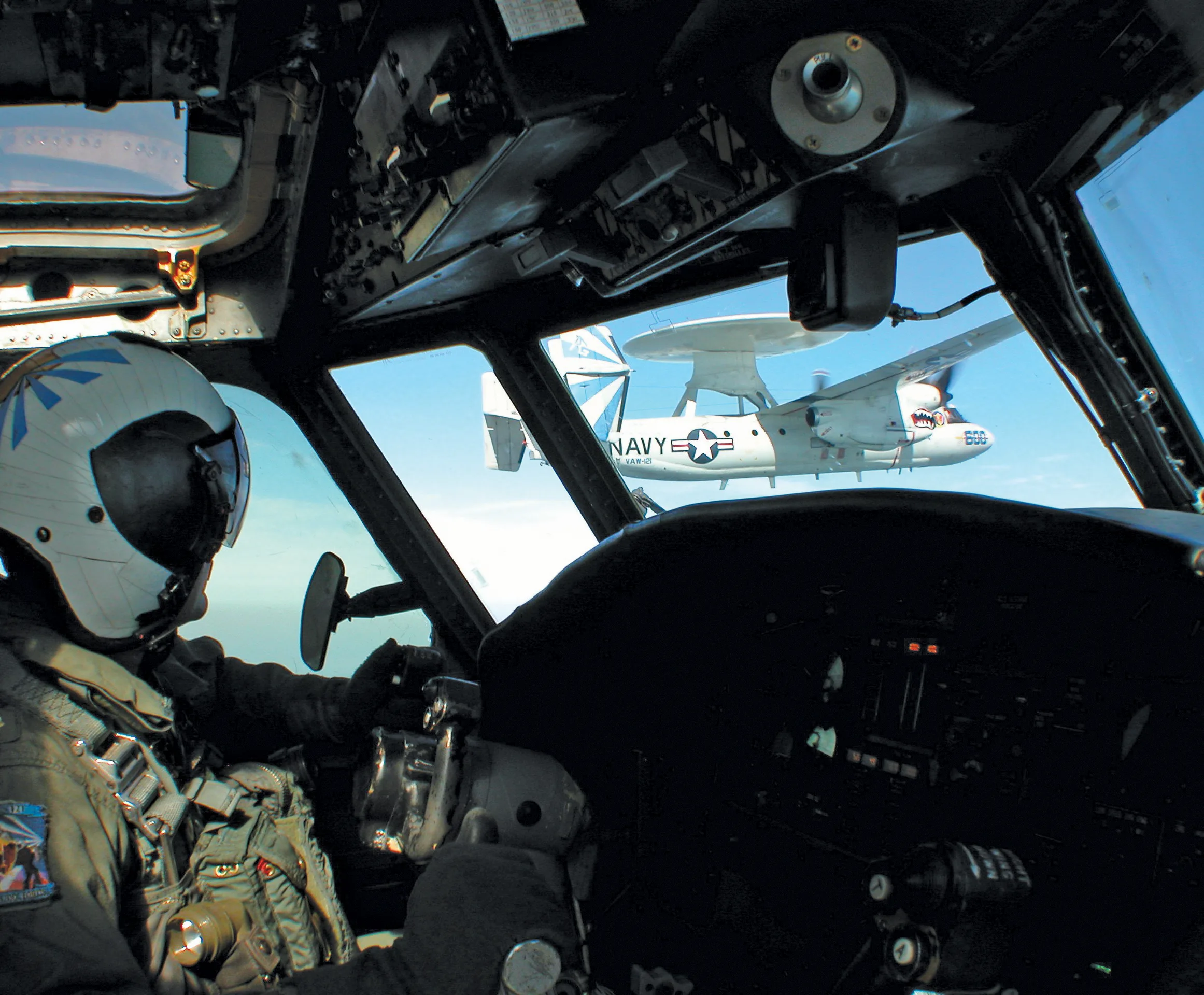
Sitting in the cockpit of an E-2 Hawkeye, Commander Bobby Hanvey ’00, USNR (Ret.), wasn’t going to miss a chance to wish his father, Colonel Stephan “Steve” Hanvey ’69, USMCR (Ret.), a happy birthday.
With the assistance of a friend in Iceland, the Hanveys connected via a high frequency radio on Steve’s 57th birthday as Bobby was conducting a combat mission in the southern part of Iraq in May 2004.
“It was pretty cool,” Bobby said. “It was neat to call Mom and Dad when they were going out to a dinner to celebrate his birthday.”
Steve Hanvey said he was impressed with the crew’s capability to coordinate the high frequency connection. He was grateful for the short call since communications from combat zones were infrequent.
“I was very surprised and pleased that he would think of me,” Steve said.
This moment galvanized their legacy as U.S. Naval Academy alumni who served their nation in combat as aviators. Steve completed 512 missions with the Seawolves as a Helicopter Attack Squadron (Light) 30 pilot in Vietnam. He is a Purple Heart and Silver Star recipient who inspired his son’s aspirations to be a pilot.
Bobby flew 39 missions in Iraq as part of Operation Iraqi Freedom. His route to a Navy career spanning three decades was a bit circuitous but filled with consequential learning lessons that shaped him into a more empathetic and effective leader.
That Bobby was able to make that birthday call in 2004 might have seemed like an unreachable dream in the fall of 1995. At that time, he was into his second class year at the Naval Academy. He felt the Academy wasn’t the right fit for him, and he turned in his resignation.
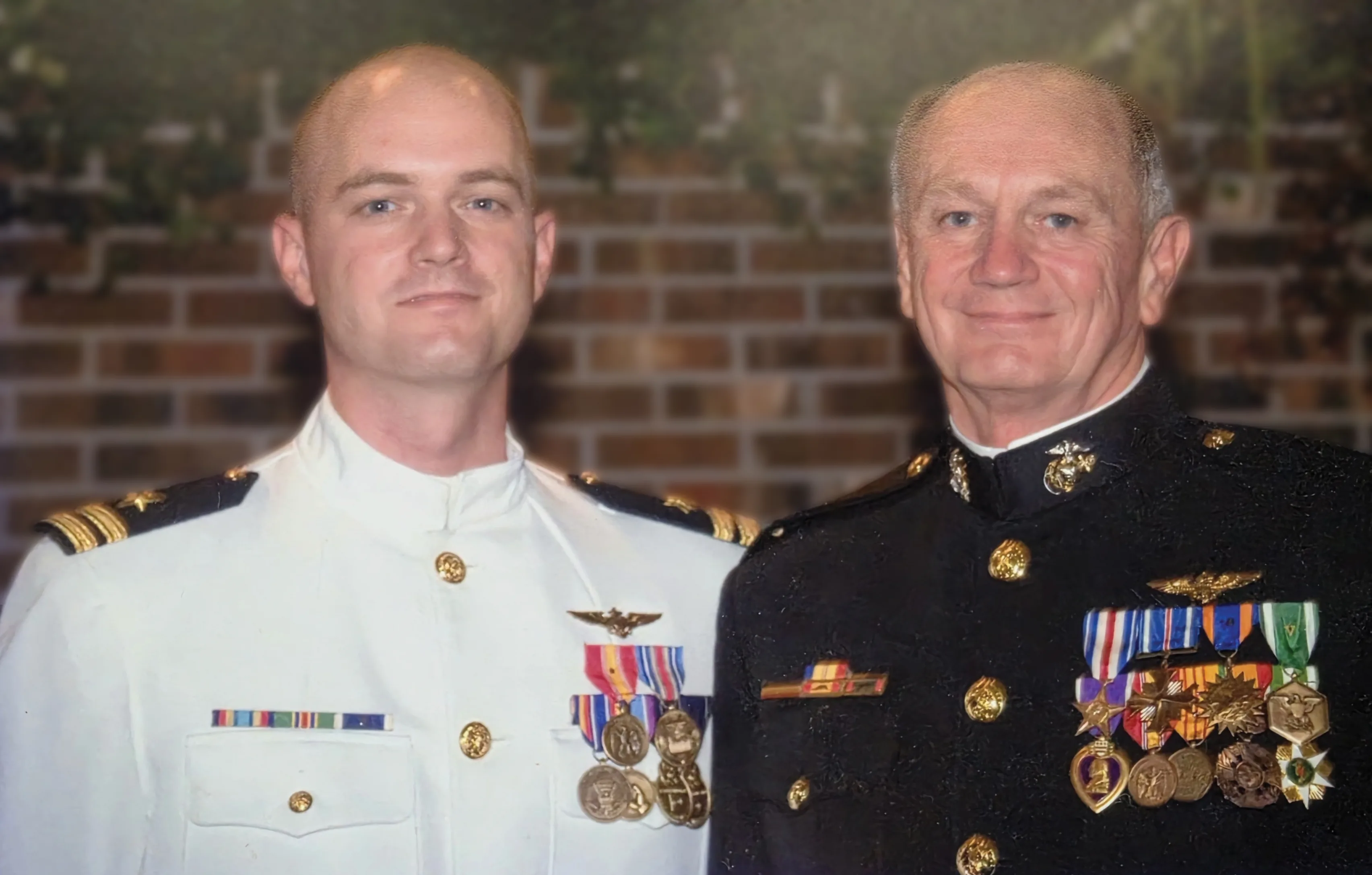
He didn’t expect it to be a problem to separate as he left at Thanksgiving. The Navy didn’t agree. Bobby was given the option of repaying $55,000 or serving for two years as an enlisted sailor.
“I didn’t have $55, much less $55,000,” Bobby said. “So, enlisted it was.”
Bobby was an undesignated seaman who eventually transitioned to a designated airman but his journey was filled with hurdles. He was frequently asked why he left the Academy. Since he survived Plebe Summer and two years in Annapolis, he bypassed boot camp, which became another unwelcomed line of questioning from his shipmates.
He said his only wish was to be in a squadron far from the Naval Academy. He was ordered to a ship in Norfolk. Bobby accepted his lot, put his time in and ultimately gained a greater appreciation for the contributions of enlisted sailors. It’s a perspective he said he wouldn’t have had if he’d commissioned with the Class of 1997.
Bobby returned to the Academy as a midshipman in the fall of 1998, getting credit for the two years he completed. He understands questions about his career path, but he wouldn’t change anything.
“It was absolutely the right choice for me to leave,” he said. “I wasn’t mature enough. I wasn’t ready and I don’t know that I would have, looking back, been a very good officer when I graduated. I would have made it, I believe, but I think I just would not have done very well. I needed that two years to understand myself and it gave me a much better appreciation on the enlisted side.
“It’s just an appreciation and an understanding what it’s like to be on the back end of the whip and not being told why you’re having to stay until four even though your work’s done at 12. Talk to the guys. Explain to them what’s going on. They don’t always necessarily agree or understand it, but at least they’re being told or they feel like they’re being heard.”
Midshipmen Again
Years of watching others fly only kept Bobby’s aviation ambitions alive. In February 1998, he’d completed his enlisted obligations and in April he was visiting his sponsor family and dropped into the Naval Academy’s admissions office on a Monday to ask if he could reapply. He was told he was allowed but the deadline for the fall of 1998 had passed.
The dean of admissions was consulted and Bobby learned he could still reapply, but they needed his application in two days because the admission board was meeting that Friday. Two weeks later, he was re-admitted.
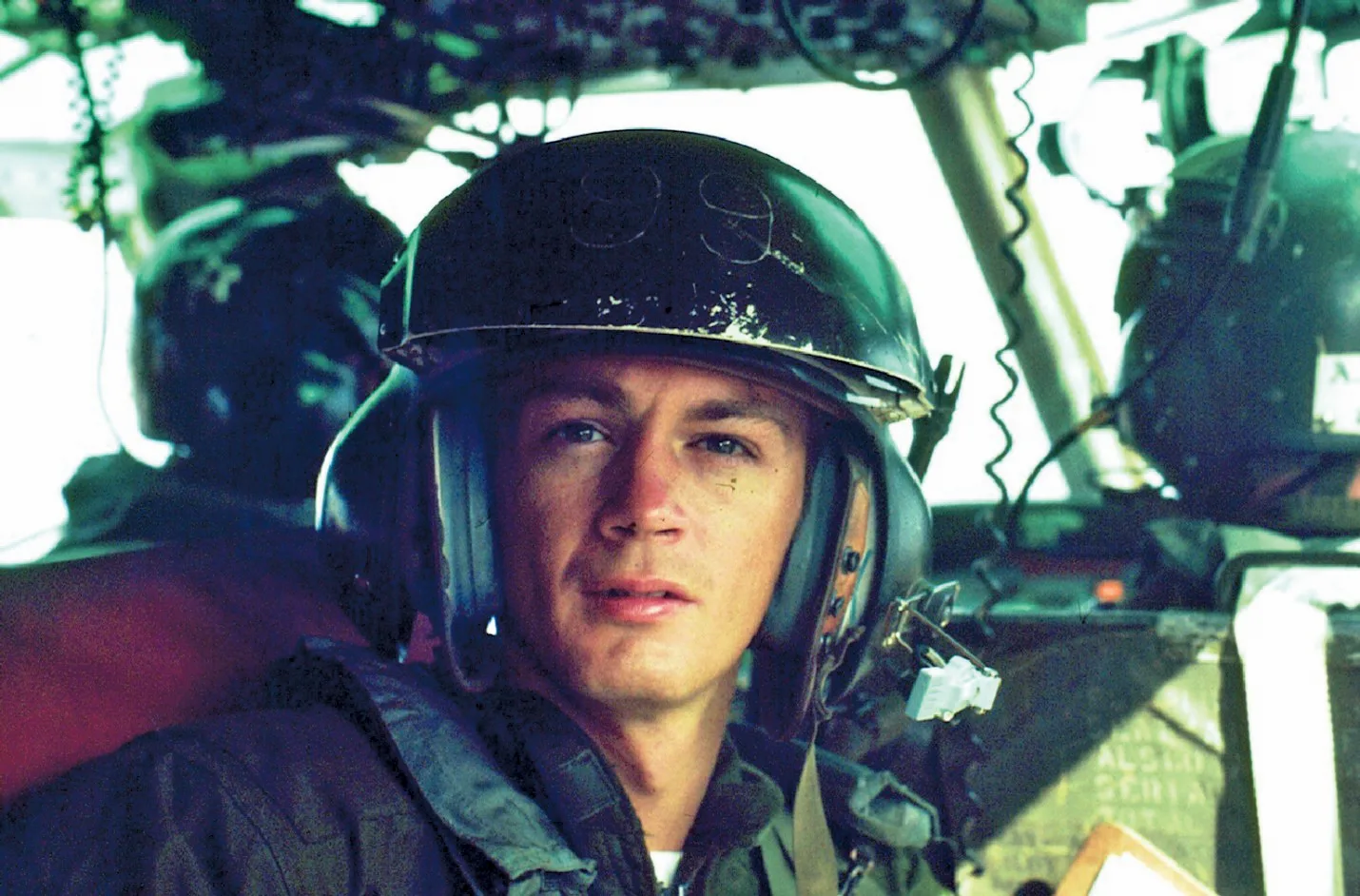
Bobby was on academic probation the first semester and he switched majors from mechanical engineering to general engineering. He acknowledged the arduous academic rigor, particularly after spending two to nearly three years away, but he was determined to complete his mission.
“I might have been miserable the first two years, but I just did two years enlisted,” he said. “I said, ‘I can do anything for two years,’ so I’d rather finish out than continually tell people I left.”
Things Changed
Bobby commissioned with the Class of 2000 and into naval aviation. On 9/11, he was in a pre-flight briefing when the hijacked commercial planes hit the World Trade Center towers in New York City.
“All of us who were serving at the time, knew things changed,” said Bobby who retired in 2022.
He said training was paused for two weeks but each pilot was eager to finish and get out to the fleet. Bobby reflected on his father’s service. Deploying to Vietnam was expected when Steve Hanvey was matriculating through the Academy.
While his son was preparing to enter combat, Steve said he didn’t offer any specific words of advice. However, Bobby said his father’s actions reverberated in terms of caring for his people and serving humbly. Values quietly demonstrated in uniform and at home, made an impact on the younger Hanvey.
On 28 August 1971, then-Lieutenant Junior Grade Hanvey was aircraft commander of a helicopter gunship shot down by enemy fire. It crashed into the mouth of the Mekong River. Facing enemy fire, Steve heard one of his crewmen call for help.
Though injured himself, his Silver Star citation says, “he swam through a barrage of small arms fire to the exhausted crewman and swam with the injured man in tow toward the middle of the river … When the injured crewman regained his strength and they were relatively safe from the enemy fire, Steve re-inflated his flotation equipment and stayed with the injured crewman in the river while still under sporadic enemy fire until rescued by helicopter.”
After returning from Vietnam, Steve served as a flight instructor at Pensacola, FL, and transferred to the Marine Corps. He would serve 11 years on active duty before transitioning to the Marine Corps Reserve where he served until 1997.
Bobby said it wasn’t until he was at the Academy that he understood his father’s heroics. Steve, who spent a couple of weeks in the hospital before flying missions again a month later, didn’t bring it up.
“It didn’t define him,” Bobby said. “The reality is not anybody would have (done what Steve did), but he didn’t think twice about it. That person is around today because of him. But to (Steve), it was just another day.”
Steve credited his family, his faith and the Naval Academy for instilling the values of servant leadership. He attributed part of his actions that day in the Mekong River to his Naval Academy training.
“As a plebe, you learn to take care of your shipmate,” said Steve, whose assignments in Vietnam included support of riverine and SEAL operations. “You just do. You don’t think, you rely on your training. I didn’t do anything special, I did what I was trained to do. We just happened to be in a bad place.”
By the time Bobby completed his post-9/11 training and got into the fleet it was mid-2003. He deployed in support of Iraqi Freedom in early 2004 in preparation for the Battle of Fallujah.
Bobby said a military commitment means one day you could be called to the front lines.
“You’ve got to be willing,” he said. “You go in the military and there’s a chance you’re putting your life on the line in some way. I understood that going in and suddenly it became very real.” ⚓